What Is n8n? The Workflow Automation Tool Explained
A clear, honest guide to n8n: what it is, how its visual workflows and AI agents work, self-hosted vs cloud pricing, and how it compares to Zapier and Make.
If you have ever wished a repetitive task would just do itself, copy new form entries into a spreadsheet, chase an invoice, post updates to Slack, that is exactly what n8n is built for. It has become one of the most talked-about automation tools, especially now that it runs AI agents. Here is a clear, honest explanation of what n8n is, how it works, and whether it is right for you.
Last checked: November 2, 2026. Pricing and limits change; confirm the current details on n8n's site.
What n8n actually is
n8n is a node-based workflow automation platform. Each "node" is a step, a trigger (something that starts the flow), an app action (create a row, send a message), a bit of logic, or an AI model. You connect nodes left to right on a canvas, and when the trigger fires, data flows through each step automatically.
It was founded by Jan Oberhauser and first released publicly in 2019, and the company is based in Berlin. It connects to well over a thousand apps and services, and because any node can also run custom JavaScript or Python, it bridges the gap between simple no-code tools and fully hand-coded integrations.
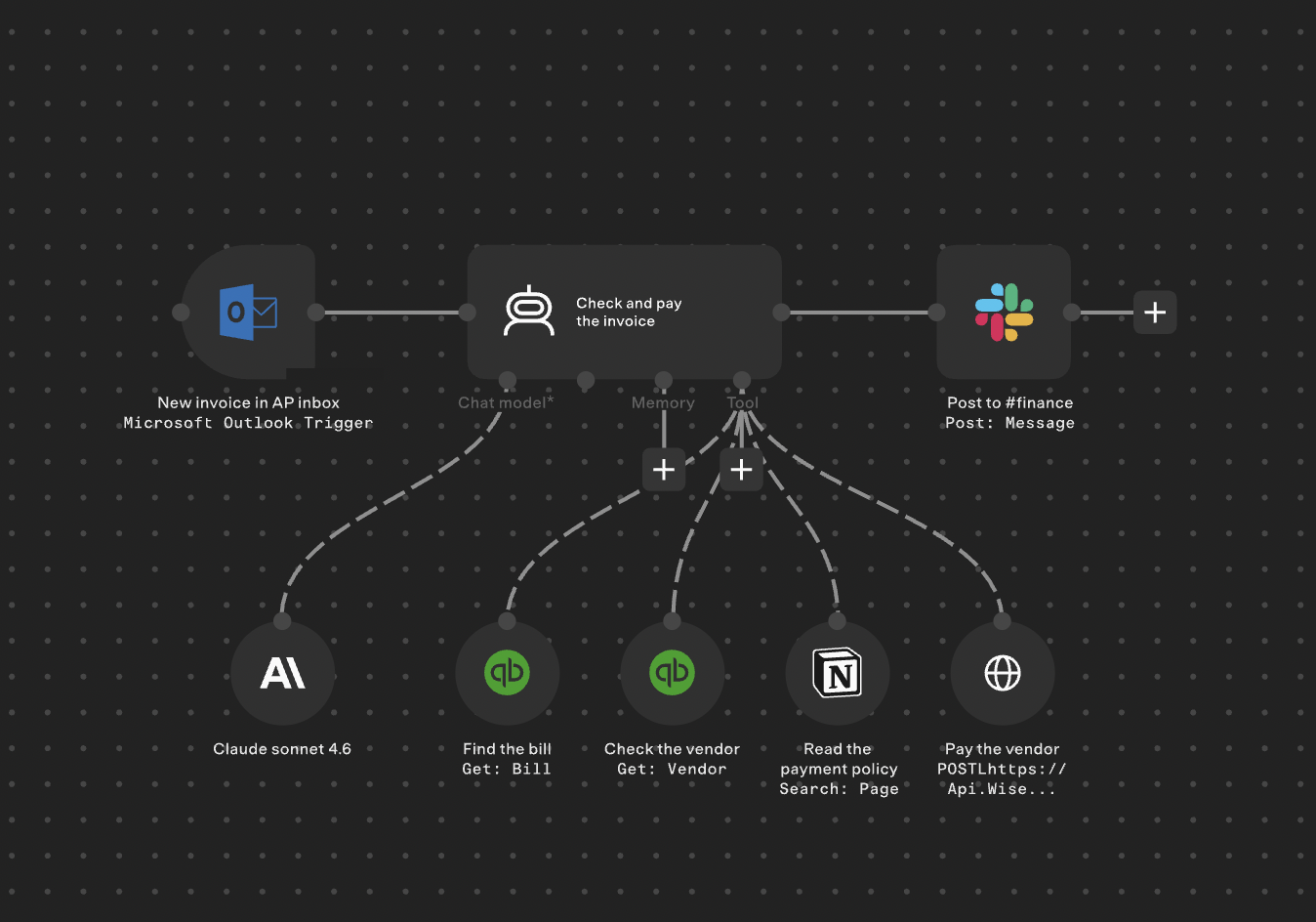
How a workflow works (using the example above)
The screenshot above is a real n8n workflow, and it is a good way to see the idea in action. Reading it left to right:
- Trigger: "New invoice in AP inbox" watches a Microsoft Outlook mailbox.
- AI screening: an AI agent node (powered by a Claude model) reads the invoice and decides what to do.
- Tools the agent can use: read-only lookups in QuickBooks to find the matching bill and check the vendor.
- Human in the loop: a Slack message asks finance to approve the payment, and the workflow waits for a reply.
- Action: once approved, it calls the Wise API to pay the vendor, then posts a confirmation to a #finance channel.
That single flow replaces a chain of manual steps, and the AI agent handles the judgment in the middle. This is the shift that made n8n popular: workflows are no longer just "if this, then that," they can reason.
Self-hosted vs cloud: the key decision
The biggest choice with n8n is where it runs.
| Self-hosted (Community) | n8n Cloud | |
|---|---|---|
| Cost | Free software; you pay for the server | Paid subscription |
| Execution limits | None | Billed per execution per month |
| Data control | Full, stays on your server | Hosted by n8n |
| Setup effort | You install and maintain it | Ready to use instantly |
| Best for | Technical users, high volume, privacy | Convenience, no server admin |
Self-hosted Community Edition is free: you run it on your own server (often a small cloud box costing only a few dollars a month) and there is no cap on how many workflows or executions you run. The trade-off is that you set it up and keep it updated yourself.
n8n Cloud removes the server work. n8n hosts everything, and you pay a monthly subscription. The important detail many people miss: Cloud is billed by the number of workflow executions, not by the number of workflows, so a few busy automations can use your allowance faster than a long list of rarely-triggered ones. Tiers have historically started around €20 per month for a couple of thousand executions and rise steeply for higher volumes [check current pricing on n8n's site, as it changes].
Is n8n open source? The honest answer
You will often see n8n called "open source," but the precise term is fair-code under a Sustainable Use License. In plain terms:
- The source code is public, and you can self-host it free for your own internal use.
- You cannot take n8n and resell it as your own hosted service to other people.
So it is source-available and extremely open in practice, but not an OSI-approved open-source license. If licensing purity matters to you, that distinction is worth knowing.
n8n vs Zapier vs Make
These three come up together constantly. The short version:
| n8n | Zapier | Make | |
|---|---|---|---|
| Ease for non-coders | Moderate | Easiest | Easy |
| Flexibility & custom code | Highest (JS/Python) | Limited | Moderate |
| Self-hosting | Yes (free) | No | No |
| AI agents built in | Yes | Growing | Growing |
| Best for | Control & flexibility | Simplicity | Visual power users |
- Zapier is the friendliest for non-technical people and has the largest app directory, but it is cloud-only and can get expensive at volume.
- Make sits in the middle with a strong visual builder.
- n8n gives the most control, the option to self-host, and first-class custom code and AI agents, in exchange for asking a little more technical comfort.
If you are weighing bundled convenience against flexible, best-in-class pieces more broadly, our guide on all-in-one vs separate tools applies the same thinking to your wider software stack.
Pros and cons
Pros
- Free, unlimited self-hosted option with full data control
- Visual canvas plus custom JavaScript/Python when needed
- AI-native: build agents and multi-step AI workflows
- Huge library of app integrations
- No execution caps when self-hosted
Cons
- Steeper learning curve than Zapier
- Self-hosting means you maintain the server
- Cloud billing is per execution, which can surprise you
- Fair-code license is not true open source
Who n8n is best for
- Technical freelancers and small teams who want powerful automation without per-task pricing, especially if self-hosting.
- Anyone building AI agents or workflows that need to call tools, make decisions, and keep a human in the loop.
- Privacy-sensitive work, since self-hosting keeps data on your own infrastructure.
Who should probably look elsewhere: complete non-coders who want the simplest possible setup and never want to touch a server may be happier starting with Zapier, then graduating to n8n later. If you want AI assistants for everyday tasks rather than full automations, see our guide to the best AI tools that actually save time.
A note on cost and running it cheaply
One reason n8n is popular with budget-conscious builders is that a self-hosted instance can run on a small server for only a few dollars a month, with no execution meter. That makes it a natural fit for the kind of lean setup we describe in the zero-budget software stack, provided you are comfortable doing the initial setup.
Our verdict
Frequently asked questions
What is n8n used for?
n8n is a workflow automation tool. You connect apps, APIs, and AI models on a visual canvas so tasks run automatically, for example, when a new email arrives, extract the details, update a spreadsheet, and post to Slack. It can also run AI agents that make decisions inside a workflow.
Is n8n free?
The self-hosted Community Edition is free to run; you only pay for the server it runs on. n8n also offers a paid Cloud service where it hosts everything for you, billed by the number of workflow executions per month.
Is n8n open source?
Not strictly. n8n is source-available under a fair-code 'Sustainable Use License.' The code is public and free to self-host for your own use, but the license restricts reselling n8n as a hosted service to others. It is not an OSI-approved open-source license.
Is n8n better than Zapier or Make?
It depends. Zapier is the easiest for non-technical users; Make sits in the middle; n8n offers the most flexibility and control, especially if you self-host or want to run custom code and AI agents. n8n rewards a bit of technical comfort with far fewer limits.
Do I need to know how to code to use n8n?
No, you can build many workflows by dragging and connecting nodes. But n8n is more powerful than pure no-code tools because any node can run custom JavaScript or Python when you need it, so light coding knowledge unlocks a lot more.
Related reading
Best AI Tools for Freelancers: What Actually Saves Time
The best AI tools for freelancers that actually save time, from writing and admin to design and scheduling, with honest guidance on where AI helps and where it doesn't.
How to Choose Between All-in-One Freelance Software and Separate Tools
Should you use one all-in-one freelance platform or separate best-in-class tools? A clear framework to decide based on cost, workflow, and how you like to work.
The Zero-Budget Freelance Software Stack (Best Free Tools in Every Category)
Build a complete freelance software stack for free: the best no-cost tools for invoicing, accounting, time tracking, project management, security, and AI.
The Postman Story: How a Side Project Transformed API Testing
How Postman began as a free Chrome side project in 2012 and grew into the API platform used by tens of millions of developers, reshaping how APIs are built and tested.